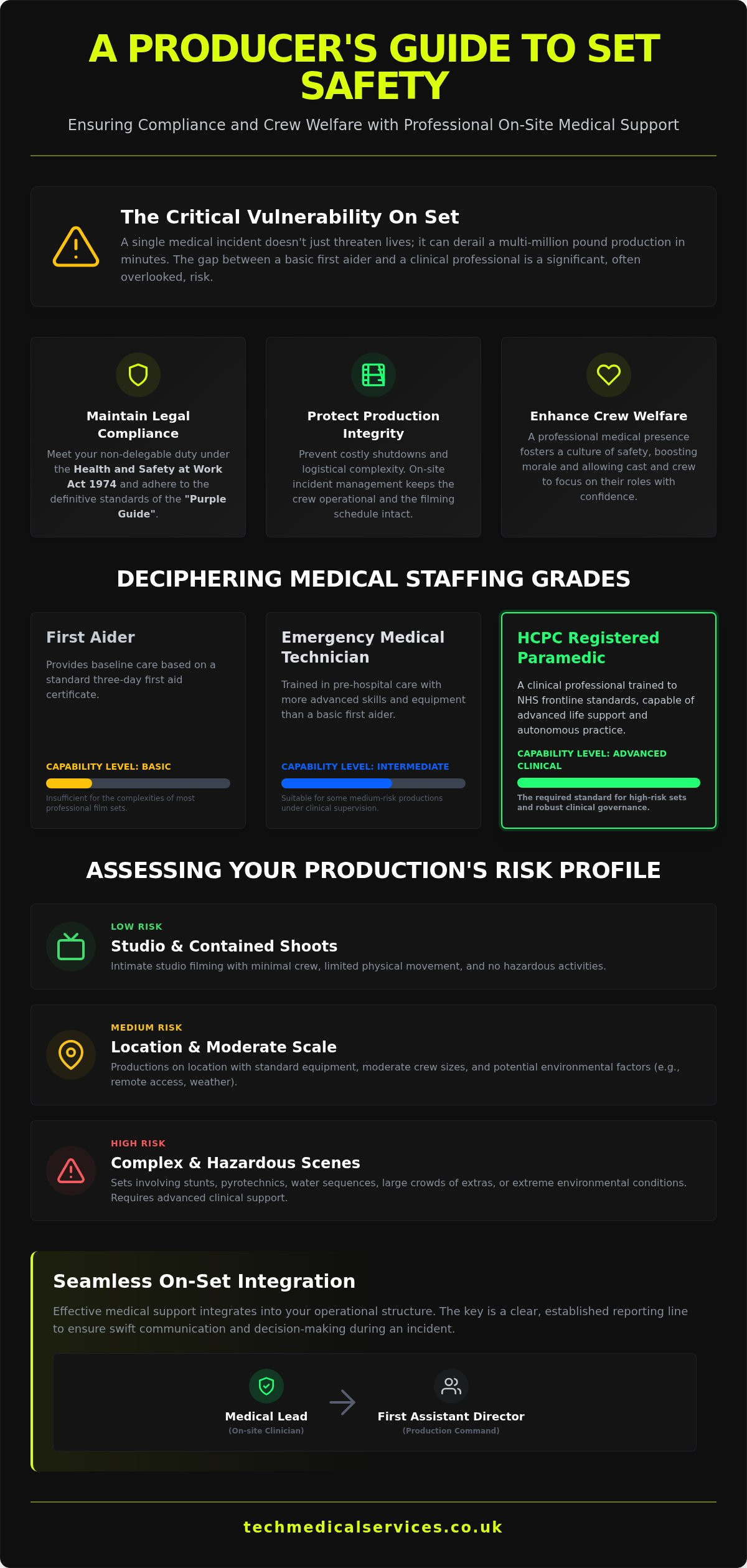

A single medical incident on set doesn't just threaten lives. It can derail a multi-million pound production in minutes. When the cameras are rolling and the stakes are high, the gap between a basic first aider and a clinical professional becomes a critical vulnerability. You're likely familiar with the intense pressure of maintaining a tight shooting schedule whilst ensuring every member of your cast and crew remains protected. The uncertainty surrounding Purple Guide requirements and the fear of avoidable production delays are significant burdens for any producer. We recognise that securing reliable on-site medical for film crews shouldn't be a matter of guesswork or compromise.
This guide provides the professional clarity you need to navigate UK health and safety regulations with absolute confidence. You'll learn how to secure compliant, NHS-standard medical support that integrates seamlessly into your production environment. We will break down medical staffing grades, explain CQC-regulated activities, and show you how to maintain operational integrity on set. This briefing offers a clear roadmap for professional safety, ensuring your production stays on track and your team stays safe.
Key Takeaways
- Master the principles of clinical governance to meet your legal obligations under the Health and Safety at Work Act 1974.
- Identify how to scale your medical provision based on crew size and the specific environmental risks of your filming location.
- Learn the critical differences between staffing grades to ensure you deploy competent on-site medical for film crews rather than just baseline first aiders.
- Optimise set safety by establishing structured reporting lines between your medical lead and the first assistant director.
- Reduce production overheads and logistical complexity by utilising local, NHS-standard medical teams for South East film hubs.
Table of Contents
- The Essential Role of On-Site Medical Support for Film Productions
- Assessing Your Production Risk Profile: A Step-by-Step Guide
- Deciphering Medical Grades: Paramedics vs. EMTs vs. First Aiders
- How to Seamlessly Integration Medical Teams into Your Production
- Securing Professional Film Set Medics in Kent and the South East
The Essential Role of On-Site Medical Support for Film Productions
Set safety is not a passive requirement. It is an active discipline. Professional on-site medical for film crews represents the backbone of clinical governance on any production. It ensures that medical response is not just reactive but integrated into the operational structure of the shoot. This level of oversight moves beyond simple first aid; it establishes a framework of professional duty and clinical excellence that mirrors NHS frontline standards.
Under the Health and Safety at Work Act 1974, production companies carry a non-delegable duty to ensure the welfare of all personnel on set. Compliance is a mandatory operational requirement. The "Purple Guide" serves as the definitive standard for UK production safety, outlining the specific medical provisions required based on detailed risk profiles. Adhering to these standards is essential for maintaining legal standing and ensuring that the production remains within the bounds of UK regulatory frameworks.
The history of film and television accidents demonstrates that unforeseen incidents can escalate with devastating speed. Without professional intervention, a minor injury can lead to a full production shutdown. A professional medical presence protects the production budget by managing incidents on-site. This prevents unnecessary hospital transfers and keeps the crew operational, ensuring that the filming schedule remains intact even when challenges arise.
Duty of Care and Liability Management
A standard three-day first aid certificate is insufficient for the complexities of a modern film set. High-occupancy environments and high-risk stunts demand on-site medical for film crews that consists of clinical professionals trained in pre-hospital care. Robust clinical governance can help in managing insurance premiums by demonstrating a commitment to professional standards. Detailed medical documentation is also vital. It provides an objective, professional record that protects production managers during any subsequent legal or insurance reviews.
Supporting Crew Welfare and Mental Health
Production schedules are gruelling. Long hours and remote locations in Kent create unique physiological and psychological stresses for the team. A quietly capable medical presence provides more than just trauma response; it fosters a culture of safety that directly boosts crew morale. When personnel know that expert clinicians are standing by, they can focus entirely on their creative and technical roles. This professional reassurance is a cornerstone of a productive and disciplined set environment.
Assessing Your Production Risk Profile: A Step-by-Step Guide
Risk isn't static. It evolves with the production's complexity and environment. A multi-camera setup in a Dartford studio requires a different clinical posture than a large-scale stunt sequence in the rural expanses of Ashford. To build an effective safety net, production managers must quantify every variable. This begins with the scale of the operation. A crew of fifty carries a baseline risk, but adding three hundred background extras significantly increases the statistical likelihood of a medical incident. When the headcount rises, the demand for on-site medical for film crews scales proportionally to ensure response times remain within clinical safety limits.
Environmental factors are equally critical. Remote locations in Ashford often present extraction challenges that aren't present in urban centres. If your set is twenty minutes from the nearest paved road, your medical team must be equipped for prolonged field care. Duration and intensity also dictate the risk profile. Night shifts and extreme weather conditions lead to fatigue, which is a primary driver of workplace accidents. Engaging professional FILM & TV Medical Support during the pre-production phase ensures these variables are accounted for before the first call sheet is issued.
Categorising Risk: Low, Medium, and High-Risk Sets
We classify sets into three distinct tiers to determine staffing levels. Low-risk sets typically involve intimate studio shoots with minimal physical movement. Medium-risk productions move to locations with standard equipment and moderate crew sizes. High-risk sets involve stunts, pyrotechnics, or water sequences. These scenarios demand advanced clinical interventions. For high-risk deployments, the presence of on-site medical for film crews must include practitioners capable of managing traumatic injuries in high-pressure environments.
Developing a Bespoke Medical Plan
A bespoke plan is a mission-critical document. It maps out emergency egress routes and identifies the nearest appropriate A&E centres. Equipment selection is based on this geography. A remote Ashford field might require a fully equipped 4x4 ambulance, whilst a studio shoot may only need a centralised trauma station. Communication protocols are the final piece of the architecture. We establish direct reporting lines between the lead medic and the 1st AD. This ensures that if an incident occurs, the response is immediate, disciplined, and coordinated with local emergency services.
Deciphering Medical Grades: Paramedics vs. EMTs vs. First Aiders
Professional medical provision is often misunderstood in the production office. A 'First Aider' is a baseline workplace requirement. It isn't a medical solution for high-stakes environments. Relying on basic certificates for complex sets introduces significant clinical risk. Professional on-site medical for film crews requires staff trained to NHS pre-hospital standards. This ensures your team can handle more than just minor cuts. They're prepared for life-threatening trauma and acute medical emergencies.
The distinction lies in the depth of training and clinical authority. Commercial first aid courses focus on basic stabilisation until help arrives. In contrast, clinical professionals provide that help on-site. They operate under strict governance. They use advanced assessment tools and evidence-based protocols to manage patient care without immediate evacuation to a hospital. This keeps your crew working and your production moving.
When to Deploy a Registered Paramedic
HCPC-registered Paramedics are essential for any set featuring stunts, pyrotechnics, or high-risk special effects. Their advanced life support skills allow for immediate intervention in critical scenarios. Paramedics possess the clinical authority to administer controlled medications and perform invasive procedures. Their superior assessment skills often prevent unnecessary production delays. They accurately diagnose minor issues that might otherwise trigger an over-cautious emergency call-out. This expertise is a mission-critical asset for any high-risk production.
The Role of the Emergency Medical Technician (EMT)
EMTs provide robust, mid-level clinical support. They're ideal for general crew safety and the management of minor injuries that occur during standard production activity. Trained to First Response Emergency Care (FREC) standards, they bridge the gap between basic first aid and advanced paramedic care. On larger productions, EMTs work alongside Paramedics to provide comprehensive on-site medical for film crews, ensuring every incident receives a professional response. They represent a disciplined and cost-effective solution for maintaining set safety without compromising on clinical standards.
How to Seamlessly Integration Medical Teams into Your Production
Successful integration of on-site medical for film crews relies on a posture of quiet capability. The presence of a medical team should never compromise the creative vision or disrupt the rhythm of the set. The medical station must be strategically positioned to be accessible for emergencies whilst remaining outside the camera's eyeline and away from lighting rigs. For sprawling sets or multi-unit shoots, we deploy mobile response units. This ensures that clinical interventions are never more than a few minutes away, regardless of where the action is happening on the location.
Reporting lines must be established before the first take of the day. The Lead Medic reports directly to the 1st AD, creating a single, authoritative point of contact for safety decisions. Professional conduct is non-negotiable. Our teams understand set etiquette and maintain absolute discretion at all times. They stay in the background until required, allowing the cast and crew to work without distraction. This disciplined approach ensures that safety is a constant, reassuring presence rather than an intrusive one.
Logistics and Deployment in Remote Locations
Rural Kent locations such as Ashford and Cranbrook present specific logistical challenges for on-site medical for film crews. Off-road film sets require specialised 4x4 medical vehicles to navigate rugged terrain and ensure patient extraction remains possible in all conditions. We ensure our teams are entirely self-sufficient, providing their own power, shelter, and communication links. This independence prevents the medical footprint from draining production resources or complicating the unit base layout. Contact us today to arrange professional FILM & TV Medical Support for your next location shoot.
Daily Briefings and Incident Reporting
The medic is an essential participant in the morning safety briefing. During these toolbox talks, we outline the specific risks for the day's call sheet and confirm emergency signals with the entire crew. Standardising Incident Report Forms (IRFs) is a core part of our clinical governance. These records provide the production office with a clear, professional audit trail that is essential for insurance compliance and post-incident reviews. We manage minor ailments like headaches, dehydration, or small abrasions whilst remaining focused on immediate emergency readiness. This proactive care prevents small health issues from escalating into production-stopping incidents, ensuring the safety of the crew is never a bottleneck for the filming schedule.
Securing Professional Film Set Medics in Kent and the South East
Local provision is a strategic operational asset. For productions based in Maidstone, Ashford, or Dartford, the advantages of regional expertise are clear. Hiring local on-site medical for film crews eliminates the logistical burden of travel expenses and overnight accommodation costs. It ensures that your medical team arrives on set fresh and fully prepared for deployment. This regional focus allows for a more efficient use of the production budget, directing funds toward clinical quality rather than travel logistics.
Knowledge of the local healthcare infrastructure is vital for emergency planning. Our teams possess detailed insights into regional trauma centres and A&E response times across the South East. We understand the specific layout of facilities like the William Harvey Hospital in Ashford or Darent Valley in Dartford. This familiarity allows for precise emergency egress mapping. Tech Medical Services operates as a quietly capable partner, providing clinical excellence grounded in regional operational awareness.
Why Local Expertise Matters for South East Productions
Navigating the logistics of Canterbury and Tunbridge Wells locations requires more than just a map. It requires an understanding of local traffic patterns and regional constraints. We maintain established relationships with regional healthcare trusts and local authorities. This facilitates smoother coordination during large-scale deployments or high-risk sequences. For last-minute shoots in the Maidstone area, our regional presence allows for rapid response capabilities that national providers cannot match. We provide the security of a local partner with the standards of a frontline emergency service.
How to Book Your Production Medical Support
The booking process is a structured, professional consultation. We begin by reviewing your risk assessments and production scale to determine the exact level of cover required. This ensures your medical package is tailored to your specific needs, avoiding the costs of over-provision whilst maintaining absolute compliance with the Purple Guide. We provide a clear briefing on staffing grades and equipment deployment before any crew arrives on set. This transparent approach ensures that your safety team is fully integrated before the first take. Enquire about on-site medical for your film crew today to secure a partner committed to your production's safety and operational integrity.
Operational Integrity through Professional Medical Governance
Securing compliant on-site medical for film crews is a non-negotiable step in modern production management. We have outlined how the correct medical staffing grades and local South East expertise protect your project from avoidable delays. By adhering to Purple Guide standards and the Health and Safety at Work Act 1974, you ensure that your set remains a disciplined and secure environment. Risk is managed through clinical discipline. Our team provides NHS-standard qualified personnel who specialise in high-risk stunt and SFX medical support. We bring extensive experience to Kent and South East locations, operating as a quietly capable partner that stays in the background until the moment of need. Maintaining clinical excellence allows your cast and crew to focus on the creative process without compromising on safety. Your production deserves a medical partner that understands the high-stakes nature of the frontline. Secure Professional Film Set Medics for Your Next Production and move forward with absolute confidence in your set safety protocols.