A rogue aerial shell turns an orderly family evening into a frontline trauma scene in seconds. Relying on well-meaning volunteers with basic bandages won't protect your casualties or your organisation. Specifying professional event medical cover for fireworks displays in Kent is now a mission-critical operational requirement, not an administrative box-ticking exercise. If you're liaising with Safety Advisory Groups across councils like Maidstone, Ashford, or Canterbury, you already know the intense pressure of balancing complex risk assessments, updated Purple Guide requirements, and genuine public safety fears.
This operational guide shows you how to specify, plan, and secure NHS-standard medical cover for public and private fireworks displays across Kent. We examine the modern shift towards Medical Needs Assessments, establish statutory acute referral pathways through the South East Burns Network, and outline the clinical standards needed to satisfy emergency services, insurers, and local licensing authorities without compromise.
Key Takeaways
- Pyrotechnic displays carry complex blast, ocular, and severe thermal hazards that require advanced pre-hospital trauma management rather than basic first aid.
- Transitioning to a structured Medical Needs Assessment under updated Purple Guide standards ensures your event medical cover for fireworks displays in Kent satisfies multi-agency Safety Advisory Groups without delays.
- Deploying autonomous clinicians qualified to NHS pre-hospital care standards guarantees rapid definitive treatment on site and shields organisers from devastating clinical negligence claims.
- Robust site zoning, isolated firing perimeters, and dedicated blue-light egress corridors maintain emergency access even amidst dense crowd conditions.
- Early procurement and rigorous governance vetting protect your public liability insurance and prevent last-minute regulatory interventions by local authorities.
Table of Contents
- Clinical Risks of Fireworks Displays: Why Specialist Medical Cover Is Mandatory
- Kent SAG Compliance and The Purple Guide: Determining Medical Resource Allocations
- Volunteer First Aiders vs Frontline Pre-Hospital Clinicians: Capability Breakdown
- Operational Deployment on Display Night: Triage, Zones, and Clear Routes
- Commissioning Firework Medical Cover in Kent: Procurement and Compliance
Clinical Risks of Fireworks Displays: Why Specialist Medical Cover Is Mandatory
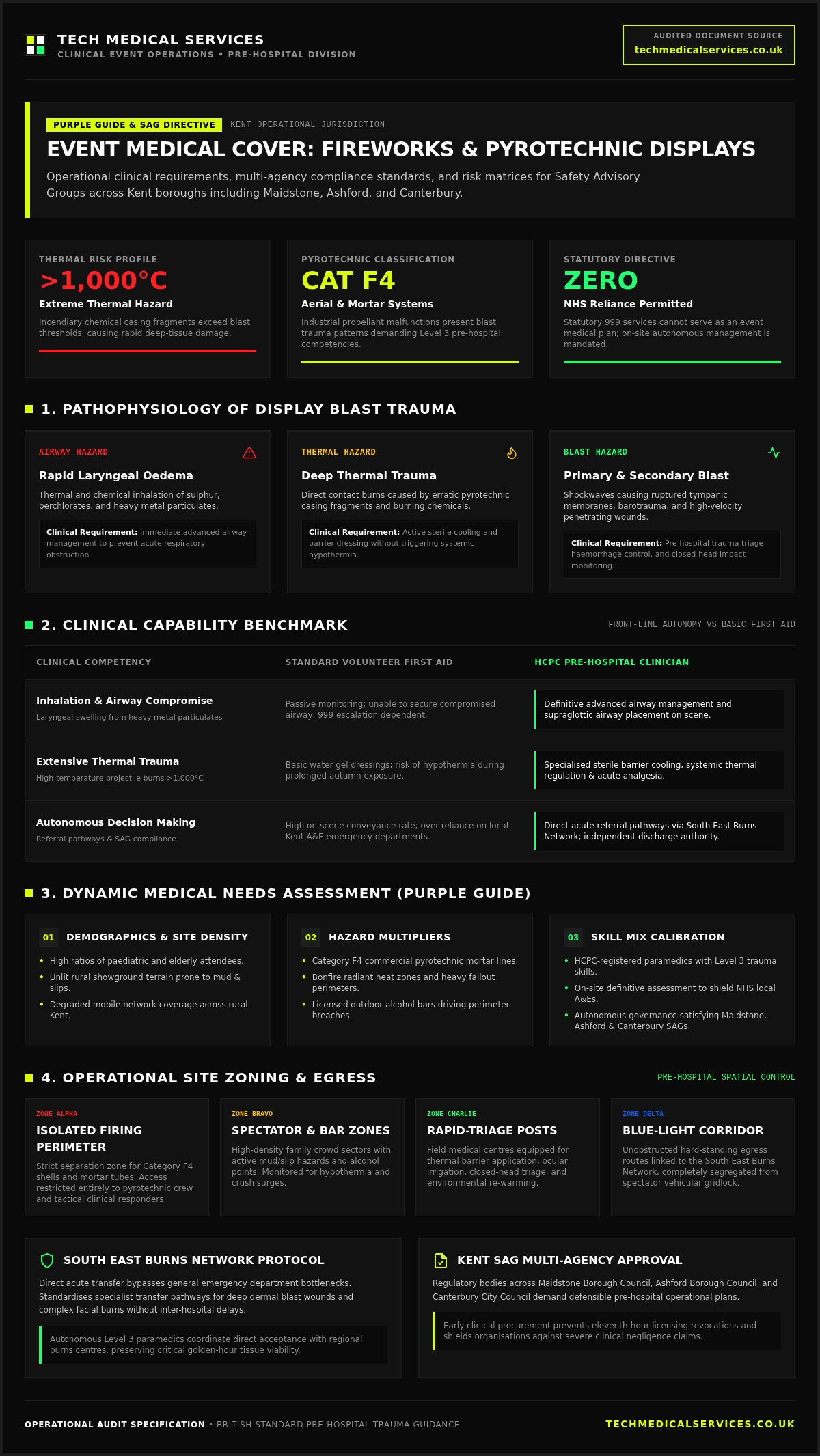
Pyrotechnic displays combine explosive propellants, extreme temperatures exceeding 1,000°C, dense crowds, and minimal lighting. Minor superficial burns represent only a fraction of display-night casualties. When a display shell malfunctions or detonates at ground level, the resulting trauma mimics an industrial blast scene. Securing dedicated event medical cover for fireworks displays in Kent ensures organisers deploy clinicians capable of handling complex multi-system injuries on scene, rather than relying on standard first aid kits.
Thermal, Blast, and Respiratory Trauma Profiles
High-velocity projectile strikes from ruptured mortar tubes or errant category F4 fireworks cause severe penetrating trauma. Clinical teams must understand the complex pathophysiology of blast injuries, where shockwaves cause primary barotrauma alongside secondary fragmentation wounds. Immediate clinical assessment involves:
- Airway compromise: Thermal and chemical inhalation of sulphur, perchlorates, and heavy metal particulates causes rapid laryngeal oedema, necessitating immediate advanced airway management.
- Deep thermal trauma: Contact burns from casing fragments or burning incendiary chemicals demand active cooling and sterile barrier dressing without inducing systemic hypothermia.
- Blast concussions: Ruptured tympanic membranes and closed-head impacts require urgent pre-hospital trauma triage.
Without frontline clinicians trained to NHS pre-hospital trauma standards, these catastrophic injuries rapidly deteriorate into systemic shock before an emergency ambulance can navigate display traffic.
Environmental and Crowd Hazards in Autumn Conditions
November pyrotechnic events introduce challenging environmental variables. Rural Kent showgrounds in Maidstone, Ashford, and Canterbury frequently turn to thick mud, driving up slip, trip, and major fracture rates in unlit spectator areas.
Sustained exposure to low ambient temperatures worsens patient outcomes. Paediatric and elderly casualties succumb to hypothermia rapidly whilst immobilised on damp ground. Additionally, alcohol consumption around outdoor bars amplifies crowd surge risks and aggressive behaviour near safety perimeters. Resilient event medical cover for fireworks displays in Kent establishes rapid-triage posts that manage environmental exposure, coordinate spinal immobilisation in difficult terrain, and protect statutory NHS resources from unnecessary presentation surges at local emergency departments.
Kent SAG Compliance and The Purple Guide: Determining Medical Resource Allocations
Safety Advisory Groups across Kent scrutinise medical operational plans with forensic detail. Regulators from Maidstone Borough Council to Canterbury City Council no longer accept generic formulas or reliance on statutory 999 services. The revised guidance from the Events Industry Forum establishes a clear mandate: the NHS is not an event backup plan. Your event medical cover for fireworks displays in Kent must present an autonomous clinical infrastructure capable of definitive on-site assessment, triage, and management.
Calculating Your Event Medical Footprint
Modern compliance replaces obsolete scoring tables with a dynamic Medical Needs Assessment. To establish an auditable deployment, evaluate your operational variables methodically using The Purple Guide medical matrix:
- Demographics and site density: Factor in high ratios of young children, elderly attendees, dark rural terrain, and poor mobile network connectivity.
- Hazard multipliers: Account for professional Category F4 aerial shells, heavy fallout zones, bonfire radiant heat, and licensed alcohol bars.
- Skill mix calibration: Balance first responders with autonomous, HCPC-registered paramedics who possess Level 3 pre-hospital trauma competencies.
This structured assessment translates crowd risk profiles into a defensible clinical tier, ensuring medical resources directly counter your site's physical vulnerabilities.
Navigating Kent Borough Safety Advisory Groups
Municipal SAGs operate strict administrative windows. For gatherings between 1,000 and 9,999 spectators, councils like Maidstone, Ashford, and Dartford mandate a comprehensive medical plan submitted at least 12 to 14 weeks prior to display night. Events exceeding 10,000 attendees require six months' lead time. Submissions are processed via digital platforms like EventApp, where stakeholders from Kent Police, Kent Fire and Rescue Service (KFRS), and the South East Coast Ambulance Service NHS Foundation Trust (SECAmb) evaluate multi-agency interoperability.
SECAmb clinical liaison officers will immediately reject proposals that depend on public ambulances for minor thermal incidents. Your documentation must evidence dedicated on-site treatment capacity, robust medical governance, and pre-identified emergency Rendezvous Points (RVPs). When organising high-liability pyrotechnic displays, partnering with experienced professionals for compliant event medical cover guarantees your operational plans satisfy regional SAG reviewers on initial submission.
Volunteer First Aiders vs Frontline Pre-Hospital Clinicians: Capability Breakdown
Volunteer first aiders provide a valuable civic service, but pyrotechnic trauma rapidly exceeds their operational scope. When high-temperature incendiaries cause deep tissue burns or concussive force disrupts an airway, basic certificates offer no legal or clinical authority to intervene effectively. Event organisers carry the legal duty of care. Booking inadequate cover introduces acute clinical vulnerability and catastrophic legal exposure. Engaging specialist event medical cover for fireworks displays in Kent bridges the gap between basic field aid and frontline emergency care.
Clinical Skill Ceilings and Intervention Limits
The operational gulf between standard first aiders and registered healthcare professionals centres on clinical autonomy, diagnostics, and pharmacotherapy. Frontline responders assess and stabilise critical trauma rapidly on scene:
- Specialised burn management: First aiders carry simple dry dressings. Registered clinicians deploy sterile non-adherent burn sheets and active cooling protocols that arrest thermal progression without triggering lethal core hypothermia.
- Advanced airway protocols: Particulate smoke and blast shockwaves induce rapid glottic swelling. Paramedics utilise supraglottic airway devices and surgical airway interventions far beyond basic first responder training.
- Pain management and POMs: Basic first aid kits contain paracetamol at best. Frontline trauma staff administer inhaled Entonox, intravenous analgesia, and Prescription-Only Medicines (POMs) under strict patient group directions.
Immediate, definitive analgesia and trauma care keep patients stable, eliminating panicked 999 calls for treatable on-site presentations.
Legal Liability and Duty of Care for Event Organisers
Under the Health and Safety at Work etc. Act 1974 and statutory HSE guidance on organising firework displays, organisers must take all reasonably practicable steps to safeguard the public. Failing to contract clinically competent providers for high-hazard displays invalidates public liability insurance policies instantly.
Insurers and prosecuting authorities scrutinise medical governance immediately following a major incident. An auditable clinical deployment requires registered clinicians with medical malpractice insurance, documented Level 3 pre-hospital trauma competencies, and formal standard operating procedures. Deploying qualified event medical cover for fireworks displays in Kent establishes defensible due diligence, proving that the medical provision matched the high-risk operational realities of your display.
Operational Deployment on Display Night: Triage, Zones, and Clear Routes
Darkness, concussive noise, and dense crowd movements create immense operational friction during pyrotechnic events. A medical plan written on paper fails instantly if clinicians cannot reach casualties or vehicles get trapped in gridlocked parking fields. Executing effective event medical cover for fireworks displays in Kent relies on tactical site zoning and disciplined movement corridors established hours before gates open to the public.
Site Mapping, Exclusion Corridors, and First Aid Posts
Static first aid facilities must never sit downwind of display fallout or within the radiant heat perimeter of a bonfire. Siting the primary treatment centre requires deliberate positioning near peripheral access gates:
- Fallout and prevailing wind buffers: Position clinical treatment posts upwind to stop toxic particulate smoke from penetrating patient triage areas or contaminating sterile equipment.
- Dispersed mobile patrols: Deploy dynamic clinician pairs carrying tactical burn packs and trauma kits directly into high-density viewing zones to treat injuries instantly.
- Sterile blue-light corridors: Enforce sterile emergency tracks protected by physical barriers. Spectator parking must never encroach on evacuation lanes connecting to arterial Kent routes like the M20, A2, or A28.
Segregating crowd movement from emergency pathways guarantees that rapid patient transport remains viable throughout the peak departure rush.
Incident Command and Multi-Agency Coordination
Frontline display safety demands strict adherence to Joint Emergency Services Interoperability Principles (JESIP). Medical commanders must maintain direct, dedicated radio links with event security, local stewards, and the senior display firer.
Predetermined escalation triggers dictate multi-agency handovers. If an aerial shell detonates low and penetrates the crowd line, clinical leads instantly initiate M/ETHANE major incident reporting whilst coordinating with on-site Kent Fire and Rescue Service teams for scene containment. Clinicians log all interventions on standard records compatible with NHS acute handovers, facilitating rapid transfer to William Harvey Hospital or regional burn units if required. To protect your display with robust incident command, book specialist event medical cover backed by NHS-standard trauma expertise.
Commissioning Firework Medical Cover in Kent: Procurement and Compliance
Demand for certified pre-hospital clinical teams peaks sharply across late October and early November. Organisers competing for qualified resources cannot afford eleventh-hour compromises. Procuring professional event medical cover for fireworks displays in Kent requires systematic operational auditing rather than simply booking the cheapest quote. Contracting an unverified provider risks immediate SAG prohibition notices, invalidated indemnity policies, and unacceptable clinical danger on site.
Essential Due Diligence and Credential Verification
Before executing any medical contract, examine your prospective provider's governance framework with rigorous scrutiny. Demand auditable evidence across three essential compliance areas:
- Clinical competency registers: Verify that lead practitioners hold autonomous HCPC paramedic or NMC nursing registrations alongside documented Level 3 pre-hospital trauma competencies. Reject generic claims of basic first aid capability.
- Indemnity and liability cover: Require comprehensive medical malpractice indemnity and public liability policies that explicitly cover invasive pre-hospital trauma care and administration of medicines.
- Standard operating procedures: Inspect current clinical governance policies governing medical gas handling, controlled pharmaceutical storage, sharps management, and clinical waste disposal.
A reputable medical contractor provides this clinical governance documentation immediately upon request.
Securing Deployment with Tech Medical Services
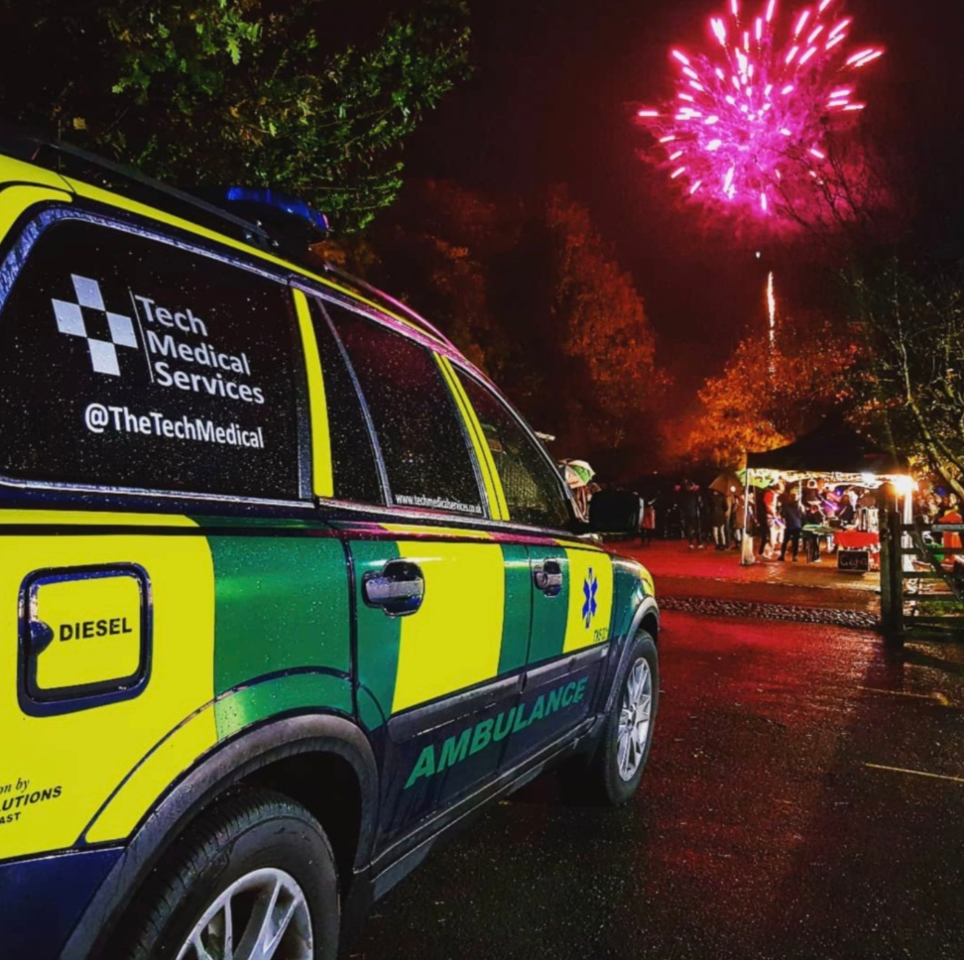
Tech Medical Services delivers elite event medical cover for fireworks displays in Kent, deploying frontline personnel qualified to NHS pre-hospital care standards. Based locally with rapid response capabilities across Maidstone, Ashford, Canterbury, Dartford, and Tunbridge Wells, our teams bring extensive operational experience in high-risk environments, including motorsport and major public gatherings.
Securing your medical deployment starts with sharing your event management plan, site layout, and crowd projections. Our clinical commanders evaluate your specific risk profile to construct an auditable Medical Needs Assessment that satisfies Kent council SAGs and aligns directly with statutory emergency services. Establish uncompromised safety standards for your display by consulting Tech Medical Services today.
Protect Your Display with Uncompromised Clinical Standards
Executing a safe public pyrotechnic event demands uncompromising preparation. Basic first aid cannot mitigate industrial blast trauma, nor will it satisfy municipal scrutiny. Event medical cover for fireworks displays in Kent must deliver resilient clinical capability that shields your organisation from liability whilst safeguarding crowds.
Tech Medical Services bridges the operational gap between basic field aid and statutory emergency services. Our frontline clinicians are qualified to NHS pre-hospital care standards, bringing extensive frontline experience across high-hazard environments. By combining rigorous Purple Guide alignment with rapid regional deployment across Maidstone, Ashford, and Canterbury, we guarantee your medical infrastructure satisfies Kent Safety Advisory Groups without friction.
Don't leave your event compliance or crowd welfare to chance. Request an operational medical deployment proposal for your Kent display to deliver a secure, spectacular evening for your visitors.