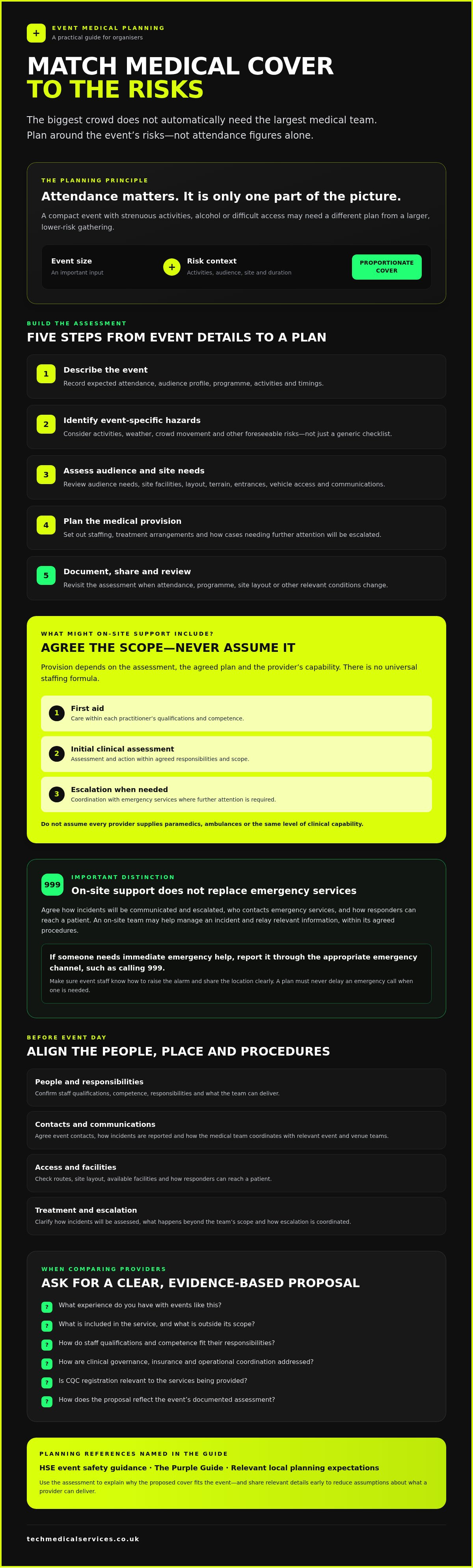
The biggest crowd doesn’t automatically need the largest medical team. Emergency medical support for events should reflect the risks on site, not attendance figures alone. A compact event with strenuous activities, alcohol or difficult access may need a different plan from a larger, lower-risk gathering.
It’s reasonable to be unsure what proportionate cover looks like. Organisers need to weigh the event’s activities, audience, location and duration, then turn that assessment into practical arrangements for staffing, treatment and escalation. Sharing these details early helps prevent assumptions about what a provider can deliver.
This guide explains how event medical support is planned, what information a provider needs to assess your event, and what to ask about staff qualifications, clinical governance, insurance and operational coordination. It also explains when CQC registration may be relevant to the services being provided. A structured assessment helps you make informed arrangements and clarify how the medical team will work alongside the wider event safety plan.
Key Takeaways
- Emergency medical support for events can range from first aid to clinical assessment and escalation, depending on the agreed plan.
- Build your assessment around attendance, activities, audience needs, duration, location, access and available facilities.
- Match the level of cover to the event’s assessed risks, and confirm that each team member’s competence fits their responsibilities.
- Agree contacts, access routes, communications and coordination arrangements with the relevant event and venue teams before event day.
- Ask prospective providers to explain their experience, service scope and how their proposal reflects your documented assessment.
Table of Contents
- What does emergency medical support for events include?
- How do organisers assess the medical risks at an event?
- What level of event medical cover might be appropriate?
- What should an event medical plan cover before event day?
- Choosing an Event Medical Provider in Kent & South East
What does emergency medical support for events include?
Emergency medical support for events is planned medical provision on site, separate from the public emergency response system, to provide care within an agreed scope and help escalate cases that need further attention. Depending on the event assessment and provider’s capability, this may include first aid, clinical assessment and coordination with emergency services. There is no universal staffing formula. Each event needs an individual plan.
What can an event medical team do on site?
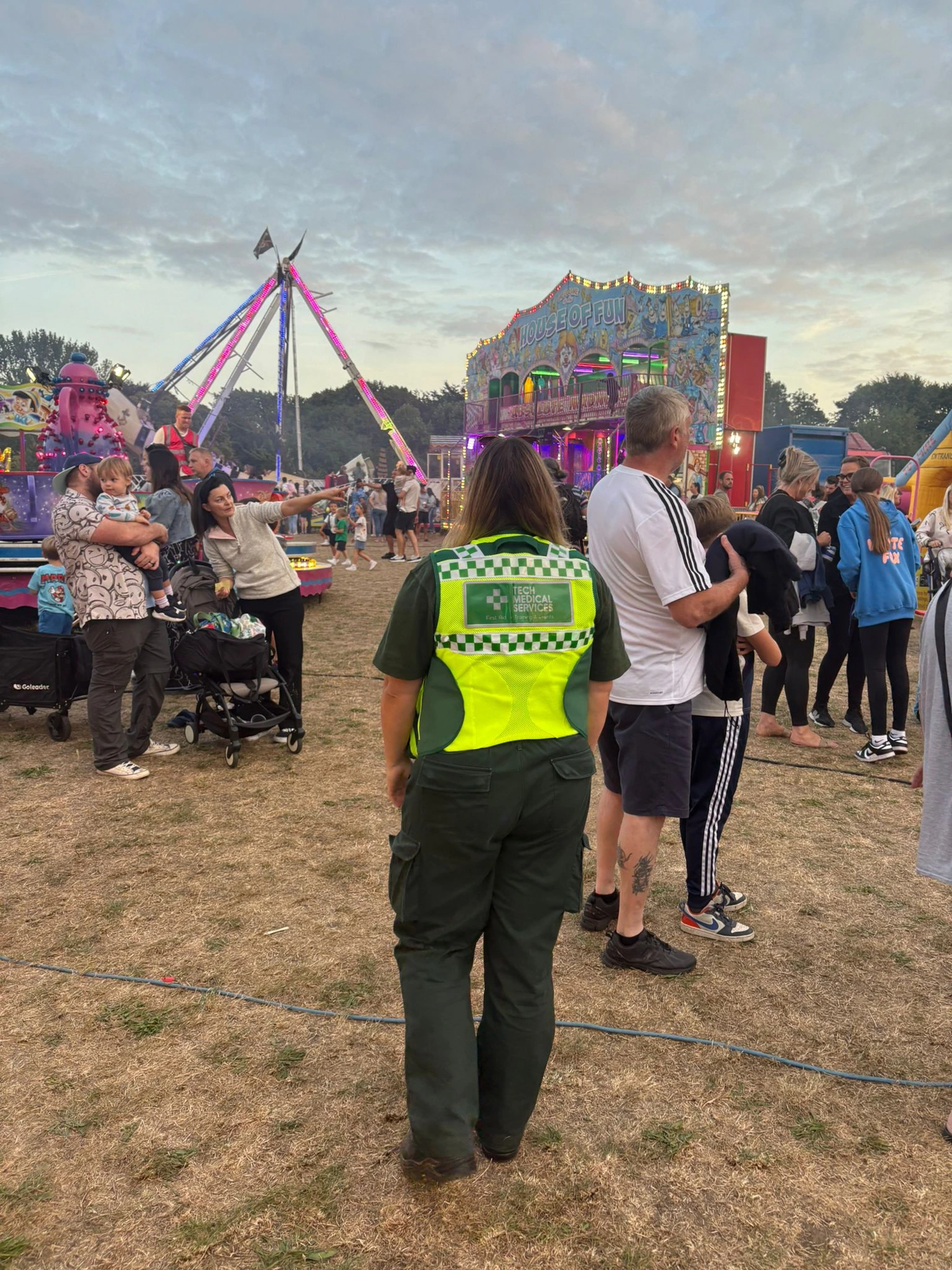
Teams can provide first aid and an initial assessment, then act within each practitioner’s qualifications, competence and agreed responsibilities. Their role may include identifying whether someone needs further clinical assessment or escalation. The care available depends on the team and the plan, so don’t assume every provider supplies paramedics, ambulances or the same level of clinical capability.
For organisers, the key question is not simply whether a team will be present. Confirm what its personnel are equipped and competent to do, how they will assess incidents, and what happens if someone needs care beyond the team’s scope.
How is event medical support different from calling 999?
On-site provision supports an event’s medical plan. It doesn’t replace the NHS ambulance service or other emergency services. The UK’s emergency response includes different services and providers, as outlined in this overview of emergency medical services in the United Kingdom.
Before the event, organisers and the medical provider should agree how incidents will be communicated and escalated. This includes who contacts emergency services and how responders can reach the patient. An on-site team may help manage an incident and relay relevant information, but escalation decisions depend on the circumstances and the team’s agreed procedures.
If someone needs immediate emergency help, report it through the appropriate emergency channel, such as calling 999. Make sure event staff know how to raise the alarm and share the location clearly. A prepared plan helps avoid confusion, but it must never delay an emergency call when one is needed.
How do organisers assess the medical risks at an event?
Start with the event, not a staffing formula. A structured assessment helps organisers identify foreseeable medical needs and decide what provision is proportionate. Work through five steps: describe the event, identify hazards, assess audience needs, plan provision, then review the plan as details change.
Attendance matters, but it is only one part of the picture. A large seated event may present different demands from a smaller event involving strenuous activity, alcohol or moving crowds. Outdoor conditions, a long programme, restricted access and limited site facilities can also affect how medical support is planned.
Which event details matter to a medical risk assessment?
Record the expected attendance, audience profile, programme and timings. Then consider the site itself: layout, terrain, entrances, vehicle access, communications and distance from suitable emergency access points. Identify hazards specific to the event rather than relying on a generic checklist. For example, consider how weather, crowd movement or a particular activity could affect attendees and access for responders.
Use HSE event safety guidance as a reference when planning and managing an event. Organisers should also consult the current edition of The Purple Guide for event-industry guidance, and check relevant local planning expectations where applicable.
How should attendance influence medical planning?
Attendance is an important input, not a standalone calculation. The same crowd size can create different requirements depending on the audience, activities, event duration and venue constraints. A remote site with limited vehicle access, for instance, presents different planning considerations from a venue with clear routes and suitable facilities nearby.
Event medical provision should be proportionate to the risks identified, not determined by crowd size alone. Use the assessment to explain why the proposed level of cover fits the event. Review it if the programme, attendance, site layout or other relevant conditions change.
- Describe: audience, programme, timings and expected attendance.
- Identify: event-specific hazards, including activities, weather and crowd movement.
- Assess: audience needs, site facilities, access and communications.
- Plan and review: document the provision, then revisit it when event details change.
A provider can help you consider how proposed cover aligns with your documented assessment. For events in Kent and the South East, you can review event medical cover from Tech Medical Services as one potential option.
What level of event medical cover might be appropriate?
There is no universal staffing ratio that determines suitable cover. The decision should follow the event’s documented risks, audience needs, site conditions and available response arrangements. The Purple Guide offers event-specific guidance to support planning, but organisers still need to consider their own event’s circumstances.
Provision may involve organiser-provided first aid, a professional event medical team, or a combination of on-site care and escalation to the emergency services. These options are not interchangeable. First aiders provide care within their training and competence. A professional team may offer a broader level of assessment or treatment, but its actual capability depends on its practitioners’ qualifications, competence and agreed scope. Confirm these details rather than relying on job titles or assumptions.
When might event first aiders be sufficient?
First aid arrangements may be suitable where the event assessment shows that foreseeable needs can be managed within the first aiders’ competence, and there is a clear route for further help if required. Consider the event profile, activities, audience, site access and how staff will summon emergency assistance. Attendance alone is not a reliable threshold for deciding. First aid provision should not be assumed to include broader clinical assessment or treatment.
When should organisers discuss professional medical cover?
Seek specialist advice if the assessment identifies complex activities, challenging access, specific audience needs or risks beyond the planned first aid arrangements. Professional cover is an option to assess, not an automatic requirement based on crowd size. Ask a prospective provider to explain what its proposed team can do, what falls outside its scope, and how it will coordinate escalation.
Some settings need particularly event-specific operational planning. Motorsport and karting involve activities and site arrangements that should be considered directly in the assessment. Film and television productions may also have distinct locations, schedules and working conditions to discuss with a provider experienced in that environment.
- Organiser-provided first aid: assess whether provision is competent and appropriate for the expected incidents.
- Professional event medical team: clarify the team’s qualifications, clinical capability and agreed responsibilities.
- Emergency-service escalation: establish how urgent incidents will be reported and how responders can access the site.
For events in Kent and the South East, organisers can consider event medical cover from Tech Medical Services as part of their assessment. The company provides support for public and private events, productions, motorsport and karting. Confirm that any proposed provision matches your event’s requirements.
What should an event medical plan cover before event day?
A medical plan turns the assessed level of cover into clear actions. It should set out who communicates with the medical team, how staff reach an incident, and what happens if a person needs further help. Share the plan with the relevant organiser, venue and event personnel so responsibilities and contact routes are understood before the site opens.
What information should organisers give a medical provider?
Give the provider current, practical information, not just the event name and expected attendance. Include the schedule, site plan, activities and known hazards. Highlight access points, vehicle routes, communication methods and relevant venue contacts. Discuss the event assessment and any assumptions behind it, such as which areas will be open or how the layout may change.
Use this checklist when briefing a provider:
- Event details: schedule, timings, activities and expected attendance.
- Site information: current layout, entrances, access routes, meeting points and relevant facilities.
- Operational contacts: named organiser and venue contacts, with agreed ways to reach them.
- Known risks: foreseeable hazards, restricted areas and any changes that could affect the medical plan.
- Response arrangements: agreed escalation process and how emergency responders can be directed to the right location.
Confirm who will keep these details up to date. A revised site map or altered programme can affect access and coordination, so the provider needs the current version.
How can teams prepare for a coordinated response?
Before opening, agree roles, contact routes, meeting points and escalation processes with the medical team and relevant event or venue staff. Make sure personnel know how to report an incident, describe its location clearly and guide the medical team to the person needing help. Where emergency services may be involved, clarify who contacts them and how responders will be directed on site.
Brief the people with operational responsibilities, and revisit the arrangements if the event plan changes. After an incident, an appropriate record and post-event review can help the organiser and provider identify what worked and what may need adjustment for future events. These practical steps support coordinated emergency medical support for events without leaving key decisions until a response is under way.
Planning cover for an event in Kent or the South East? Discuss event medical cover with Tech Medical Services as you develop your arrangements.
Choosing an Event Medical Provider in Kent & South East
Choose a provider whose proposed service matches your documented event assessment. A polished proposal is not enough on its own. Check the provider’s relevant experience, staff competence, clinical scope and operational arrangements, then confirm how these will work with your event team and venue.
What questions should you ask an event medical provider?
Ask for clear answers supported by current information. For emergency medical support for events, confirm who will attend, what roles they will perform and what care they are competent to provide. Check qualifications and any relevant professional registration directly, and ask how the provider assures ongoing competence. Where applicable, verify the provider’s current CQC registration status and the services it covers.
- Experience: Have you supported events with similar activities, audiences or site conditions?
- Capability: What qualifications and responsibilities will the deployed personnel have, and what falls outside their scope?
- Plan: How does your proposed provision reflect the event’s risk assessment and documented requirements?
- Coordination: How will you manage communication, site access, incident escalation and contact with the organiser or venue?
- Service details: What is included in the proposal, and which arrangements remain the organiser’s responsibility?
Ask the provider to explain its assumptions. For example, check whether the proposal depends on a particular site layout, access route or event schedule. Make sure any change to those details is discussed and reflected in the operational arrangements.
How can a local provider support event planning?
A provider familiar with the region may be able to discuss local site and event considerations, but location alone doesn’t demonstrate suitability. Confirm experience relevant to your event and check the service area and availability directly before making arrangements.
Tech Medical Services provides event medical and first aid cover across Kent and the South East for public and private events, subject to confirming availability. Organisers planning events in Maidstone, Ashford, Dartford, Gravesend, Canterbury, Tunbridge Wells, Tonbridge, Cranbrook, Aylesford or Staplehurst can ask how proposed cover fits their assessment and what operational information is needed. The company also provides support for productions, motorsport and karting.
Once you’ve documented your requirements, discuss your event medical requirements with Tech Medical Services.
Put your event medical plan into action
Effective emergency medical support for events starts with a documented assessment, not a standard staffing formula. Consider the event’s activities, audience, location, access and duration, then match the proposed cover to the risks identified. Be clear about what each team member is competent to do, how incidents will be escalated and who is responsible for coordination.
Before confirming arrangements, check a provider’s relevant experience, staff qualifications, service scope and operational communication. Ask how its proposal reflects your assessment, and verify credentials and service details directly. Tech Medical Services provides event medical cover for public and private events across Kent and the South East, subject to availability confirmation. Its frontline-experienced staff are qualified to NHS pre-hospital care standards. Confirm the current details of the proposed team’s qualifications when making enquiries.
With clear responsibilities and a suitable plan in place, you can make decisions with greater confidence. Discuss your event medical requirements with Tech Medical Services to take the next step towards planning appropriate cover.