If a medical emergency occurs in your chair, is your team truly ready to act, or are they simply reciting a textbook? Professional excellence in a dental surgery requires more than just theoretical knowledge; it demands the disciplined readiness of a frontline responder. You understand that meeting GDC and Resus Council UK guidelines is a non-negotiable standard, yet finding the time to organise external courses often disrupts your clinic’s essential schedule. Our dental intermediate life support training in Kent bridges this gap by bringing NHS-standard clinical expertise directly to your practice.
We promise a training experience delivered by veteran medical professionals who handle real-world emergencies every day. This approach ensures your team doesn't just earn certified CPD points, but gains the absolute confidence to manage critical situations with precision and calm. This article outlines how our on-site ILS delivery secures full GDC compliance for your entire clinical team whilst minimising operational downtime. You'll discover why training with frontline experts is the only way to ensure your practice remains a safe, high-standard environment for every patient. We focus on practical application and rigorous standards to keep your surgery mission-ready at all times.
Key Takeaways
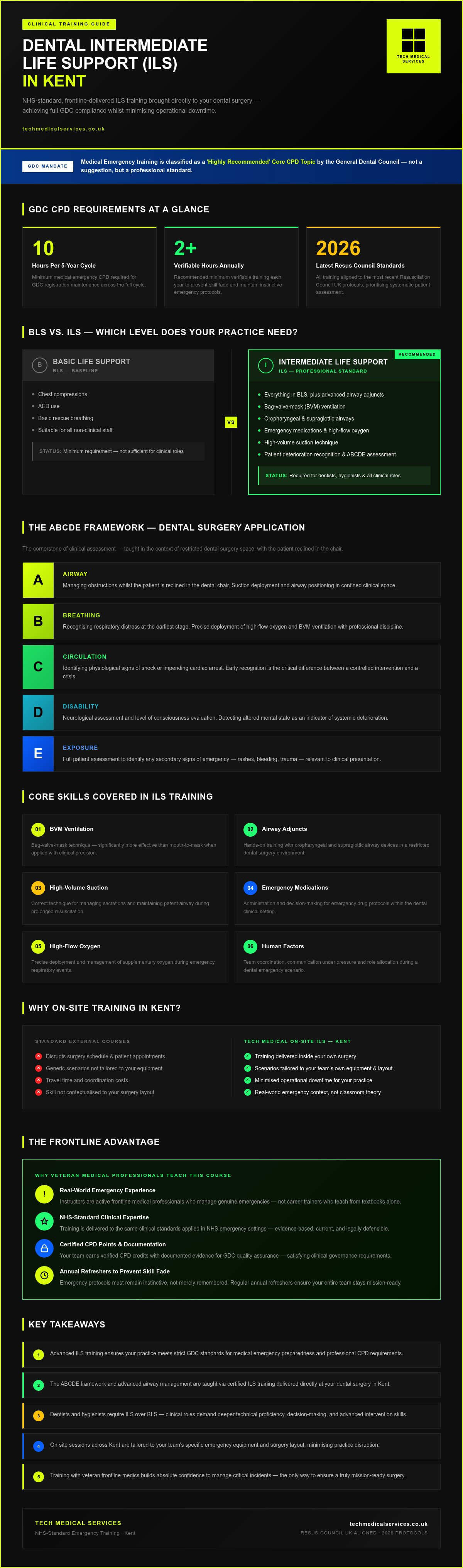
- Understand how advanced training ensures your practice meets strict GDC standards for medical emergency preparedness and professional CPD requirements.
- Master the ABCDE approach and advanced airway management through certified dental intermediate life support training delivered directly at your surgery.
- Learn why clinical roles like dentists and hygienists require the deeper clinical insights of ILS compared to standard basic life support protocols.
- Minimise practice disruption with on-site sessions across Kent that are tailored to your team's specific emergency equipment and surgery layout.
- Gain the confidence to manage critical incidents by learning directly from veteran frontline medics with extensive real-world emergency experience.
Table of Contents
- Why Dental Intermediate Life Support (ILS) is Essential for GDC Compliance
- Comprehensive Course Structure: Mastering Advanced Emergency Skills
- BLS vs. ILS: Which Training Level Does Your Practice Require?
- Organising On-Site Training in Kent: Minimising Surgery Downtime
- Expert-Led ILS Training with Tech Medical Services: The Frontline Advantage
Why Dental Intermediate Life Support (ILS) is Essential for GDC Compliance
Dental ILS is an advanced tier of life support specifically tailored for the dental clinical environment. It represents a significant step up from standard first aid. While Basic Life Support (BLS) focuses on the fundamentals of chest compressions and AED use, dental intermediate life support training provides the clinical team with the tools to manage a deteriorating patient more effectively. This includes the use of airway adjuncts, suction, and emergency medications. The General Dental Council (GDC) classifies medical emergency training as a 'Highly Recommended' core topic. This isn't a suggestion; it's a professional mandate. Safety is paramount.
The distinction between BLS and ILS is critical for clinical governance. BLS is the baseline. ILS is the professional standard for those operating in a surgery. It demands a higher level of technical proficiency and decision-making. By choosing advanced training, you ensure your practice isn't just meeting the minimum requirements but is operating at the peak of clinical safety. This disciplined approach protects your patients and your professional standing.
GDC Standards and Clinical Governance
Maintaining registration requires strict adherence to CPD targets. The GDC stipulates that dental professionals should complete at least 10 hours of medical emergency CPD per five-year cycle. We advise that this is spread across the cycle, with at least two hours of verifiable training every year. Effective dental intermediate life support training satisfies the 'Quality Assurance' aspect of clinical governance. It provides documented evidence that your practice maintains high standards of care. Annual refreshers are essential for the entire clinical team. They prevent skill fade and ensure that emergency protocols remain instinctive rather than remembered.
The Role of the Resuscitation Council UK Guidelines
Tech Medical Services aligns all training with the most recent Resuscitation Council UK standards. Our instructors are frontline medical professionals who bring real-world experience to every session. We focus on evidence-based research, particularly the latest 2026 life support protocols which prioritise systematic assessment. This ensures your team learns methods that are proven to save lives. It's about clinical excellence, not just compliance. Dental professionals hold a legal duty of care to provide emergency intervention that is competent, timely, and aligned with current UK medical standards.
Comprehensive Course Structure: Mastering Advanced Emergency Skills
A medical emergency in a dental surgery presents specific environmental challenges. Space is often restricted. The patient is frequently in a supine position. Standard classroom-based training often fails to account for these variables. Our dental intermediate life support training addresses these complexities through a disciplined, clinical framework. We move beyond basic protocols to provide a structured response system that works in the real world. It's about ensuring your team is mission-ready for any scenario.
The ABCDE Approach in a Dental Context
The ABCDE approach is the cornerstone of clinical assessment. We teach its application under high-stakes conditions. During the Airway phase, we focus on managing obstructions whilst the patient is reclined in the chair. Breathing assessments involve recognising respiratory distress early and the precise deployment of high-flow oxygen. For Circulation, Disability, and Exposure, we train your team to identify the physiological signs of shock or impending cardiac arrest. Early recognition is the difference between a controlled intervention and a crisis. We don't just teach the acronym; we teach the clinical reality.
Advanced Airway and Ventilation Techniques
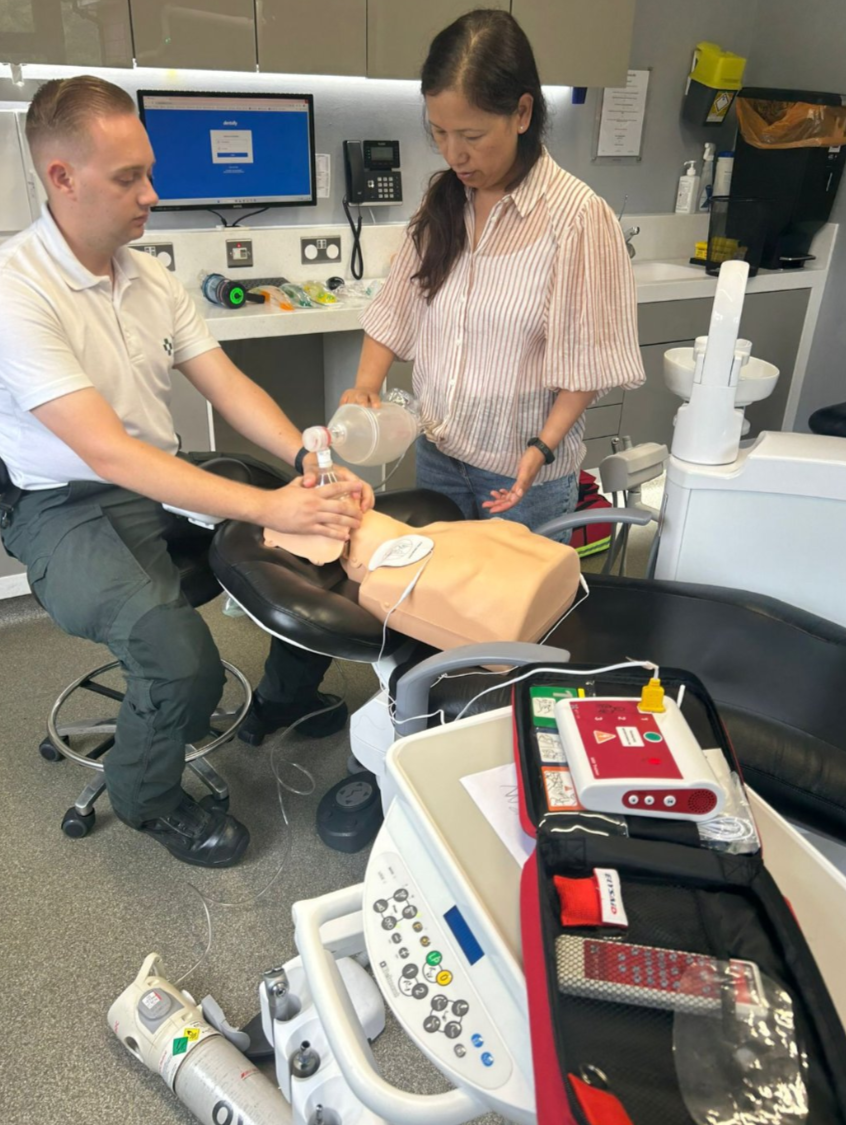
Oxygenation is the priority. Our practical workshops cover bag-valve-mask (BVM) ventilation techniques. These are significantly more effective than mouth-to-mask methods when executed with professional discipline. We provide hands-on training with oropharyngeal and supraglottic airway adjuncts, alongside the correct use of high-volume suction. These tools are essential for maintaining a patent airway during prolonged resuscitation or when managing secretions. Managing a difficult airway in a confined clinical space requires coordination. We focus on the 'human factors' that ensure the whole team works in unison.
Safe defibrillation is a non-negotiable skill. We ensure every staff member is proficient in AED and manual defibrillator use within the surgery environment. This includes pad placement, rhythm recognition, and clear communication during the shock cycle. We also provide detailed instruction on the emergency medications found in your dental kit. From adrenaline for anaphylaxis to glucagon for hypoglycaemia, we cover indications, dosages, and administration routes. Our instructors bring the urgency of the frontline to your training room. To ensure your practice is fully prepared, you can schedule a session with our professional medical trainers.
BLS vs. ILS: Which Training Level Does Your Practice Require?
Safety is a standard, not a suggestion. Whilst Basic Life Support (BLS) provides the necessary foundation for all staff, dental intermediate life support training is the professional benchmark for the clinical team. BLS focuses on high-quality chest compressions and the rapid deployment of an AED. This level is appropriate for receptionists and administrative staff who support the primary responders. However, for those operating at the chairside, the clinical demands are far greater. You need more than just the basics when a patient's life is on the line.
Intermediate Life Support (ILS) equips dentists, hygienists, and nurses with the skills to intervene before a cardiac arrest occurs. It bridges the gap between basic first aid and advanced hospital care. This training includes the use of airway adjuncts, such as oropharyngeal tubes, and the administration of life-saving medications. In a high-stakes environment like a dental surgery, these skills are mission-critical. It also establishes a clear leadership structure. During a crisis, the ILS-trained professional takes command, ensuring the team works with discipline and precision.
Identifying the Right Level for Your Team
Clinical roles require a deeper level of intervention. Dentists and hygienists must be proficient in the ABCDE assessment and the use of the emergency drug kit. If your practice offers conscious sedation or carries out complex oral surgery, ILS is the preferred risk management standard. It provides the technical proficiency to manage respiratory depression or anaphylaxis with absolute discipline. Every team member must understand their specific role within the Practice Emergency Protocol to ensure a coordinated response.
- Clinical Staff: Dentists, Hygienists, and Dental Nurses should undertake ILS to manage airway obstructions and drug administration.
- Non-Clinical Staff: Reception and administrative teams may only require BLS to support the clinical team and manage the AED.
- Sedation Clinics: Full ILS certification is essential for managing the increased risks associated with sedative agents.
CPD Points and Certification Validity
Compliance is non-negotiable. Tech Medical Services provides Level 3 VTQ equivalent certification, ensuring your training meets the rigorous standards required by the CQC and GDC. This certification is valid for one year. Annual re-qualification is mandatory to prevent skill fade and ensure your team remains sharp. We provide comprehensive documentation for every staff member, serving as verifiable proof for your clinical governance records. Our dental intermediate life support training is delivered by frontline professionals who understand the reality of medical emergencies. This ensures your CPD is not just a tick-box exercise, but a genuine enhancement of your practice's safety standards.
Organising On-Site Training in Kent: Minimising Surgery Downtime
Organising professional development shouldn't compromise patient care. Traditional off-site courses require significant travel and often result in a full day of lost revenue. Our on-site dental intermediate life support training in Kent solves this problem. We provide a disciplined, clinical training programme delivered at your surgery. This minimises downtime and ensures that the entire clinical team is trained simultaneously. It's a pragmatic solution for high-standard practices that value both time and clinical excellence. We work around your surgery hours to ensure training is a benefit, not a burden.
The Benefit of Training in Your Own Surgery
Practising 'in-situ' is a core principle of frontline medical training. It improves staff retention by placing the learning in the exact environment where it will be applied. During the session, we conduct a thorough audit of your emergency drug kits and oxygen delivery systems. We ensure your team is proficient with the specific AED models and suction units you have on-site. This practical approach identifies layout blind spots, such as restricted access for emergency responders or poor equipment placement. A well-prepared surgery is one where every second is utilised effectively. We focus on the physical reality of your workspace, ensuring that when an emergency occurs, your team moves with purpose and familiarity.
Local Delivery Across the South East
Our trainers are deployed across the South East, serving Maidstone, Ashford, and Canterbury with professional precision. We also support dental practices in Tunbridge Wells, Dartford, and Gravesend, providing tailored instruction that meets your specific clinical needs. Whether you operate a specialist sedation clinic or a general family practice in rural Kent, we adapt our scenarios accordingly. This includes specific focuses on paediatric patients or the unique risks of conscious sedation. Local clinical support is the foundation of robust community healthcare. We pride ourselves on being a reliable partner for Kent's dental professionals, offering the flexibility that national providers cannot match. To ensure your team is fully compliant and prepared, you can book your on-site training with our veteran medical team.
Expert-Led ILS Training with Tech Medical Services: The Frontline Advantage
Frontline experience is the ultimate differentiator in medical emergency training. In a high-stakes environment like a dental surgery, theory alone is insufficient. You need a team that has managed real-world cardiac arrests and respiratory failures on the frontline. Our dental intermediate life support training is built on this foundation of active clinical experience. We don't just teach from a manual; we share the disciplined, veteran expertise gained from years of NHS pre-hospital care. This ensures your practice moves beyond the basic tick-box exercise toward a culture of genuine clinical readiness. Safety is a discipline. It requires constant refinement and the guidance of those who live it every day.
Learning from Active Medical Professionals
There's a profound difference between a classroom teacher and an active frontline medic. Our instructors bring a level of authority that only comes from regular emergency response. We focus heavily on 'human factors', which are the psychological and physiological responses to stress that can compromise a team's performance during a crisis. By using realistic, high-pressure simulation scenarios, we build your team's confidence to act decisively. You'll learn how to manage the environment, the equipment, and the patient whilst maintaining the calm, reassuring presence necessary for professional excellence. These simulations are tailored to the 2026 curriculum, ensuring your skills are aligned with the latest evidence-based protocols.
Your Partner in Clinical Safety
Tech Medical Services is committed to professional duty and uncompromising quality. We've been providing clinical excellence since our founding, and our philosophy remains grounded in regulatory compliance and operational integrity. We provide more than just a certificate; we offer a partnership in safety for practices across Kent and the South East. This includes ongoing support and advice to ensure your emergency protocols remain sharp long after the training day ends. As you plan your professional development, choose a provider that leads through action and expertise rather than marketing fluff. Book your on-site Dental ILS training with Tech Medical Services to secure your practice's clinical standards and ensure your team is truly mission-ready.
Elevating Clinical Standards in Your Surgery
Maintaining high-stakes readiness is a professional duty that extends beyond simple compliance. By choosing dental intermediate life support training, you move your practice from basic first aid to advanced clinical intervention. You've seen how systematic ABCDE assessments and advanced airway management provide the foundation for patient safety. Training in your own surgery environment ensures that every second is utilised effectively when it matters most. Our instructors bring the discipline and precision of frontline NHS emergency response directly to your clinical team.
We provide certified Level 3 ILS training that is strictly aligned with Resus Council UK standards. Our bespoke on-site delivery across Kent and the South East ensures your surgery remains operational whilst your staff gain the confidence to lead during a medical crisis. It's time to replace classroom theory with the absolute reliability of veteran expertise. Secure your GDC-compliant Dental ILS training with our frontline experts today. Together, we can ensure your practice remains a centre of excellence for patient care and clinical safety.